
Dart is Google’s open-source, client-optimized language built for fast apps across mobile, web, desktop and server, and it is the language that powers Flutter. Most companies hiring Dart developers today are really hiring Flutter engineers, since the two skill sets overlap almost completely in practice, and the right hire depends more on experience level and engagement model than on the Dart-vs-Flutter label on their resume.
AB Ark provides vetted Flutter and Dart developers for hire on hourly, part-time, monthly or project-based terms. The rest of this guide covers what Dart developers actually do, how to test and interview them, what they cost by experience level, how to run the hiring process end to end, and the mistakes that most commonly derail a hire.
Key takeaways
- Dart is the language; Flutter is the framework built on it. In practice, hiring a “Dart developer” almost always means hiring a Flutter engineer.
- Beyond mobile apps, Dart also compiles to native machine code and to JavaScript, so it can power backend services and web apps from the same codebase.
- Test Dart language fundamentals (null safety, async, isolates) separately from Flutter-specific skills (widgets, platform channels), since a candidate can be strong in one and weak in the other.
- Rates scale heavily by seniority, not just region: a junior and a lead architect can differ by 5–8x on the same hourly band.
- A paid trial task reveals more about a Dart developer than a portfolio review or a resume full of logos.
Talk to Our Team About Your Project →
Why Dart and Flutter hiring demand keeps growing
Flutter is not a niche choice. Around 11% of apps released in 2024 used Flutter, ahead of React Native at 7%, according to Appfigures data. Its share of live apps has kept growing since, from 14% to 16% on the App Store and from 23% to 26% on Google Play between April 2025 and May 2026. React Native still leads among top-grossing iOS apps, with 1,350 of the top 10,000 against Flutter’s 1,184. Teams choose Flutter for its single codebase, consistent UI across platforms and fast MVP builds, and Flutter’s Q2 2026 survey reported 90%+ satisfaction in every developer segment it measures.
The package ecosystem backs this up. Flutter’s own ecosystem update reported the pub.dev package index grew 26% in 2023 alone, reaching roughly 48,000 packages by the end of that year, with more than 700,000 monthly active users on pub.dev as of January 2024. A growing package ecosystem means Dart developers increasingly build by assembling and evaluating packages, not only writing everything from scratch, which is itself a skill worth testing for (covered below).
What does a Dart developer actually do?
A Dart developer writes code in Dart, Google’s client-optimized language designed for building fast apps on any platform. Dart compiles to ARM and x64 machine code for mobile, desktop and backend targets, or to JavaScript for the web, which is what lets one Dart codebase realistically target several platforms.
In day-to-day hiring, this breaks down into three overlapping roles:
- Flutter app developer. The large majority of Dart hiring. Builds mobile, web and desktop apps using the Flutter UI framework, which Dart powers directly.
- Dart backend developer. A smaller pool. Builds HTTP servers and APIs using Dart-native frameworks such as Dart Frog or Shelf, often to share models and logic with a Flutter frontend.
- Dart package maintainer / tooling engineer. The smallest pool. Writes and maintains shared packages published to pub.dev, Dart’s package repository.
If your project is a mobile or cross-platform app, you are hiring the first type, and the rest of this guide treats “Dart developer” and “Flutter developer” as effectively the same hire, consistent with how the market actually works. What to look for depends on what you’re building:
- Real estate app: Look for experience with map and geolocation features, property search and filters, image-heavy listings, push notifications and integrations with listing or CRM systems.
- Healthcare app: Look for experience with secure data handling and privacy rules such as HIPAA or GDPR, appointment booking, health-record integrations (for example FHIR) and secure messaging or telehealth flows.
- Audio/video calling app: Look for hands-on experience with WebRTC or a calling SDK (such as Agora, Twilio or Zoom), plus native integration for incoming-call notifications, background audio and poor-network handling. Ask to see a live calling app they’ve shipped.
- Custom solution: Look for a developer who can propose an architecture and a phased MVP scope, not just write screens. Ask for a portfolio of similar products, and check that they can work with your backend and third-party APIs.
Across all four, ask for apps they’ve published on the App Store or Google Play, not just code samples.
Dart developer responsibilities by seniority
What you should expect a candidate to own changes sharply by experience level. Use this to sanity-check a resume against the role you actually need filled.
| Level | Typical experience | What they should own |
| Junior | 0–2 years | Implements screens and features from a defined design and spec; needs code review on architecture decisions |
| Mid-level | 2–5 years | Owns a feature end to end, including state management and API integration; writes tests without being asked |
| Senior | 5–8 years | Makes architecture decisions, reviews others’ code, handles platform channels and performance work unsupervised |
| Lead / Architect | 8+ years | Sets technical direction across a team, owns CI/CD and release process, mentors other engineers, evaluates build-vs-buy decisions |
What to test before you hire
Separate the interview into two halves, because a candidate can be strong in one and genuinely weak in the other.
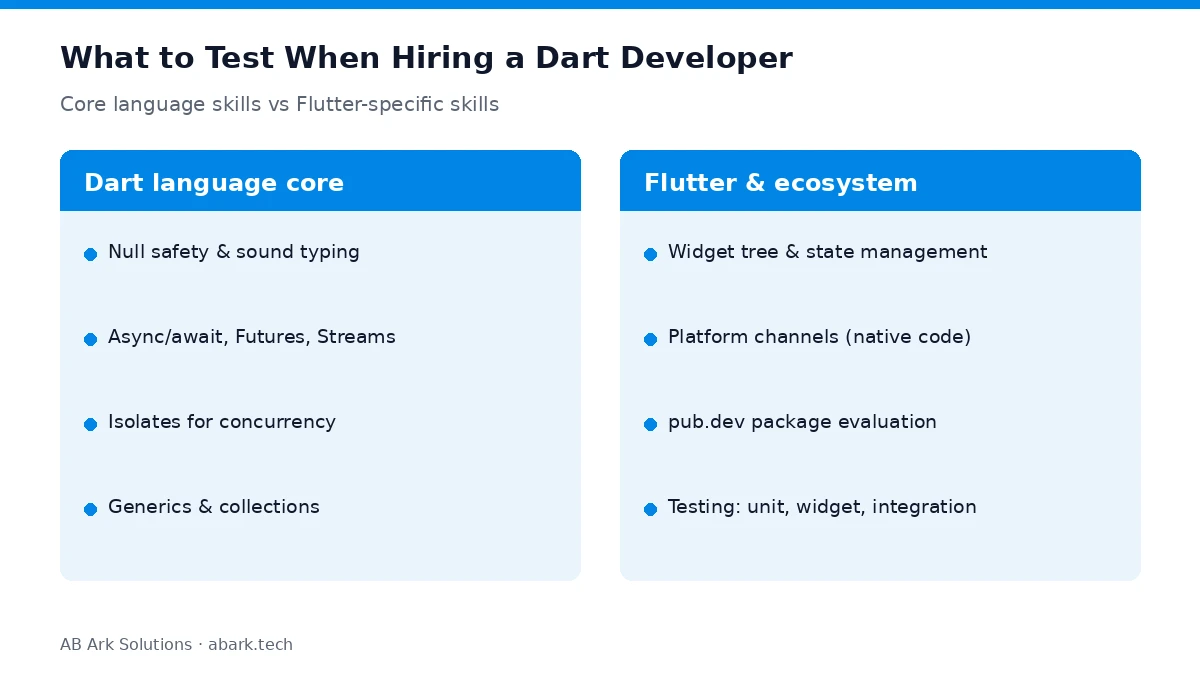
| Area | What to check | Why it matters |
| Null safety & typing | Ask the candidate to explain sound null safety and fix a nullable-type bug live | Dart’s type system is central to avoiding runtime crashes; weak understanding here shows up as production bugs |
| Async & concurrency | Review how they use Future, async/await and Streams, and when they’d reach for an isolate | Flutter apps freeze the UI thread if async work is handled incorrectly |
| Widget architecture | Have them explain a state management choice (Provider, Riverpod, Bloc) they’ve shipped with, not just studied | State management mistakes are the most common source of expensive mid-project rewrites |
| Platform channels | Ask about a time they wrote native Android/iOS code to expose a platform feature to Dart | Camera, Bluetooth, payments and background tasks usually need this; many candidates have never actually done it |
| Package judgment | Ask how they evaluate a pub.dev package before adding it as a dependency | A poorly chosen or abandoned package becomes a maintenance liability later, not an immediate one |
| Testing discipline | Ask what percentage of their last project had unit, widget and integration test coverage | Thin or absent testing is the single biggest predictor of costly bugs after handoff |
What hiring a Dart developer costs, by experience level
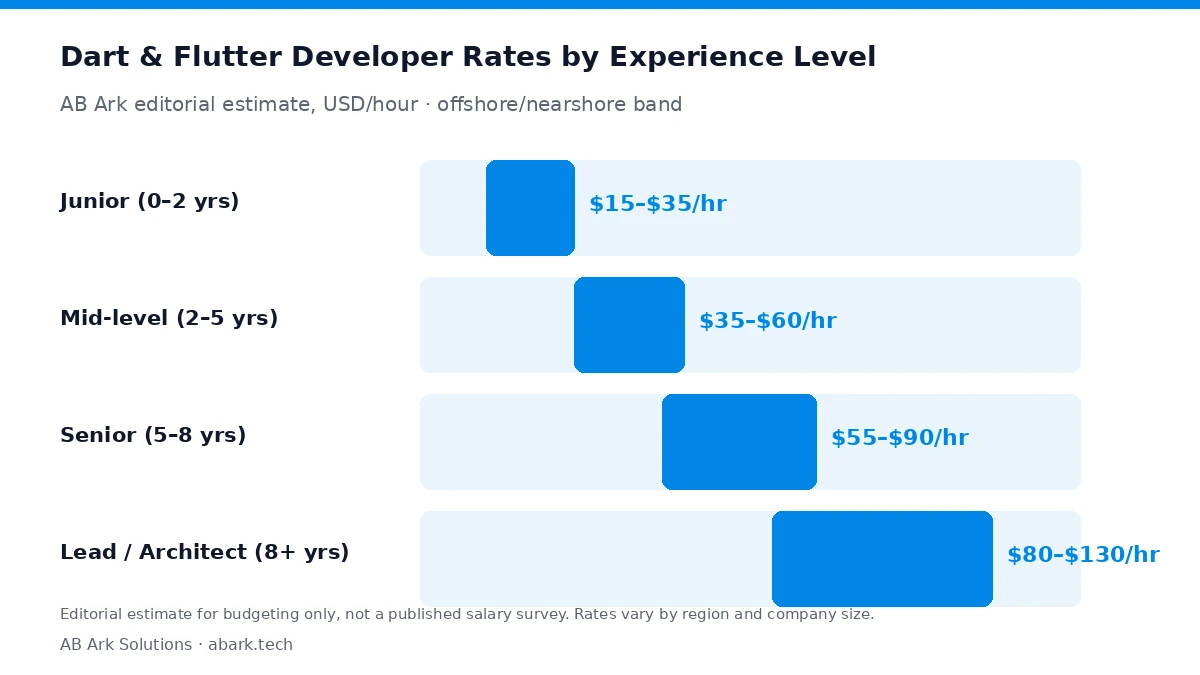 Experience level moves the rate far more than region does within the same tier. A junior developer in any country is a junior developer; the seniority gap between a junior and a lead architect, on the same offshore or nearshore band, typically runs 5 to 8 times, before region is even considered.
For a regional view across all experience levels blended together, Clutch’s November 2026 mobile app pricing guide reports $25–49/hr as typical in the US, under $25/hr in India, and $100–149/hr in Australia, based on verified client reviews across mobile development generally, not a Dart-specific survey.
Engagement models for hiring a Dart developer
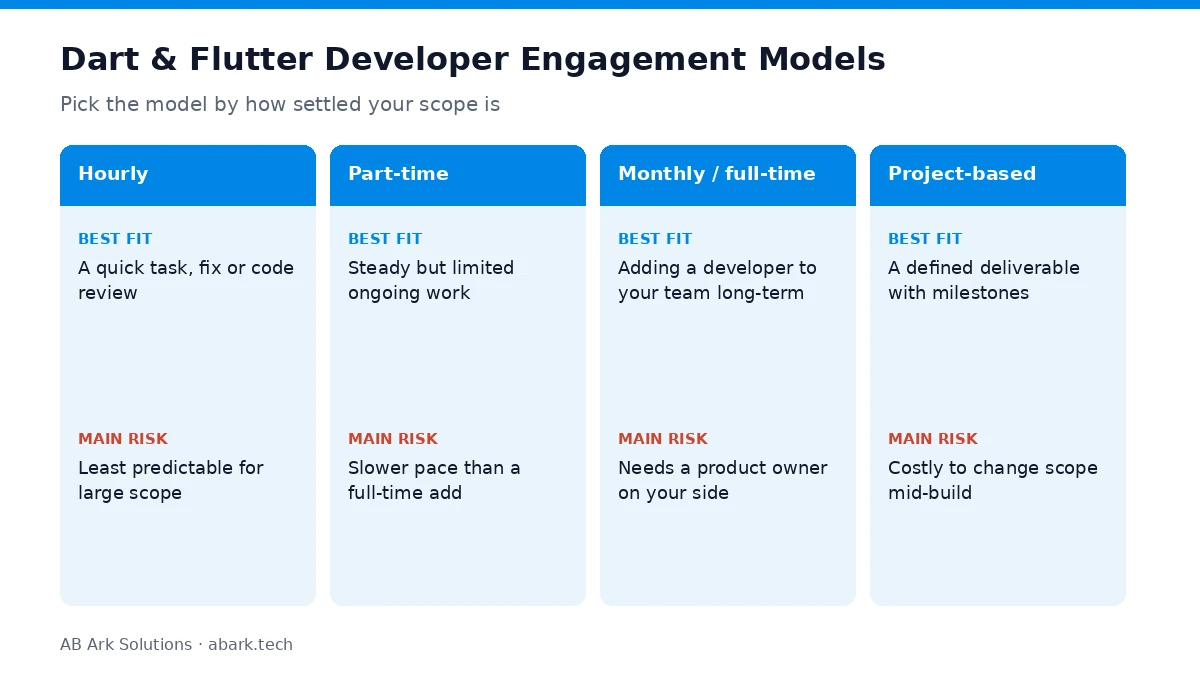
AB Ark offers Dart and Flutter developers under four models: hourly support for quick tasks and fixes, part-time support for steady but limited work, full-time monthly capacity for an ongoing team addition, and fixed-scope project-based delivery with milestones.
How to hire a Dart developer: the process step by step
- Write the scope before you post the role. List the platforms (iOS, Android, web, desktop), the state management approach if already decided, and any native integrations the app needs. A vague scope produces vague candidates.
- Screen for the right seniority, not just “Dart experience.” A candidate who has only built tutorial-scale apps is not the same hire as one who has shipped to production and handled an app store rejection.
- Run a paid trial task before committing. One real feature, ideally including a native integration or a state management decision, reveals more than any number of portfolio links.
- Check their testing habits, not just their code. Ask to see actual test files from a past project, not just hear a description of their testing philosophy.
- Confirm code and account ownership up front. Your company should own the repository, app store accounts, and any cloud infrastructure from day one, regardless of engagement model.
- Start with a defined first milestone. Even in an ongoing or dedicated engagement, the first two to four weeks should have a concrete, checkable deliverable.
Common mistakes when hiring a Dart developer
| Mistake | Early warning sign | How to prevent it |
| Hiring for “Dart” without specifying Flutter depth | Candidate knows the language but has never shipped a Flutter app to a store | Ask specifically about Flutter widget architecture and app store submission experience, not just Dart syntax |
| Skipping the native-integration check | No candidate can describe writing platform channel code | Include one native-integration question in every technical interview, even if the first project doesn’t need it yet |
| No testing requirement in the trial task | Trial task is accepted on “it works” with no tests | Require at least one unit test and one widget test as part of any paid trial |
| Treating all regions as interchangeable | Budget set from one region’s rate card applied everywhere | Price by experience level first, then adjust for region, not the other way around |
| No ownership clause in the contract | Vendor or freelancer keeps control of app store accounts after the engagement ends | Require code, store account and infrastructure ownership transfer as a condition of payment |
Where to find Dart developers
Dart and Flutter developers are available through several channels, each with a different tradeoff between speed, vetting depth and cost.
- Agencies and dedicated-team providers. Pre-vetted developers with faster onboarding; AB Ark’s own Flutter and Dart hire page is one example of this model.
- Freelance marketplaces. Wide selection and visible reviews, but vetting depth and ongoing reliability vary candidate to candidate.
- Direct hiring and job boards. Full control over the hiring bar, at the cost of a longer timeline and your own sourcing and screening effort.
- Referrals from your existing network. Often the fastest path to a known quantity, when available.
Onboarding a new Dart developer: the first 30 days
A strong technical hire can still fail if onboarding is an afterthought. In the first month:
- Give read access to the full codebase and architecture documentation on day one, not after a week of requests.
- Pair them on one existing feature before assigning a new one, so they learn your conventions instead of guessing at them.
- Set one small, shippable task for week one. A fast first merge builds momentum and surfaces environment or access problems early.
- Review their first pull request closely, including test coverage, and give specific feedback rather than a rubber-stamp approval.
A note on proof
AB Ark’s case studies page documents delivered projects across web, AI and software products. At the time of writing, we do not have a publicly disclosed Flutter or Dart project with a published cost or timeline figure to cite here.
Get a Custom Quote for Your Dart Developer →
Interview questions worth asking a Dart developer
- “Walk me through a time null safety caught a real bug before it shipped.” — tests whether they actually rely on the type system, not just tolerate it.
- “When would you reach for an isolate instead of just awaiting a Future?” — separates developers who understand Dart’s concurrency model from those who only know the syntax.
- “Describe a widget tree you had to restructure for performance.” — reveals real production experience versus tutorial-level knowledge.
- “What’s a pub.dev package you’ve evaluated and rejected, and why?” — shows judgment about dependencies, which matters more than most teams realize until a package is abandoned mid-project.
- “Tell me about an app store rejection you’ve dealt with.” — production apps get rejected; a candidate who has never shipped to a store can’t answer this.
- “What does your test coverage actually look like on your last two apps?” — a specific, honest number beats a vague “we test everything.”
- “How would you structure a feature that needs to work offline?” — checks for real architectural thinking, not just UI skill.
Frequently asked questions
Is a Dart developer the same as a Flutter developer?
In practice, almost always. Dart is the language; Flutter is the UI framework built on it. A small number of developers work in Dart outside Flutter, writing backend services with frameworks like Dart Frog or Shelf, but if you’re building a mobile or cross-platform app, you are hiring a Flutter developer who happens to write Dart.
Can Dart be used for anything besides Flutter apps?
Yes. Dart compiles to native machine code for command-line tools and backend servers, and separately compiles to JavaScript for web apps. These uses exist and are growing, but the overwhelming majority of Dart hiring demand is still driven by Flutter app development.
How much does it cost to hire a Dart developer?
Experience level matters more than region within a tier: a junior developer typically runs $15–35/hr and a lead or architect $80–130/hr on an offshore/nearshore band, by AB Ark’s editorial estimate. Blended across all experience levels, published rates for mobile app development generally run from under $25/hr in India to $100–149/hr in Australia, per Clutch’s November 2026 data.
What’s the fastest way to vet a Dart developer’s real skill level?
A short paid trial task beats a portfolio review. Give the candidate one feature that needs a native platform integration and ask them to write tests alongside it. How they handle null safety, async code and test coverage on that one task tells you more than a resume or a client testimonial.
Should I hire a junior or senior Dart developer for a new project?
For a greenfield app with no existing architecture, hire at least one senior developer to make the early structural decisions. Juniors are a good fit for implementing well-specified features under review, but letting a junior set the architecture on a new project usually costs more later than it saves now.
How long does it take to onboard a new Dart developer?
For a developer joining an existing codebase, expect one to two weeks to full productivity if onboarding is handled deliberately: codebase access on day one, a paired first feature, and a small shippable task in week one. AB Ark’s own hire page states it typically onboards developers within 48 to 72 hours of engagement start, though full productivity on an unfamiliar codebase still takes longer than onboarding logistics.
Choosing the right Dart developer
Hiring a Dart developer is, for nearly every real project, hiring a Flutter developer: match the seniority to what the project actually needs, test Dart language fundamentals and Flutter-specific skills separately, confirm testing discipline and code ownership before you confirm anything else, and run a paid trial before committing to a longer engagement.
AB Ark provides vetted Flutter and Dart developers for new builds, migrations and ongoing app work, on hourly, dedicated or project-based terms.
Schedule a Free Consultation Call →
CEO At AB Ark Solutions